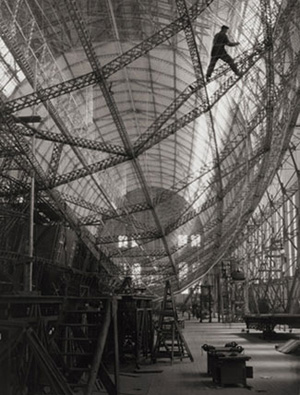
E.O. Hoppé's vintage print
The Making of the Graf Zeppelin,
Freidrichshafen, Germany, 1928
Sold at Art Basel for $21,400

E.O. Hoppé's vintage print
The Making of the Graf Zeppelin,
Freidrichshafen, Germany, 1928
Sold at Art Basel for $21,400
E.O. Hoppé Reclaims Europe at Art Basel
Presented by New York’s Silverstein Photography, a first–time exhibitor at the world’s premiere art fair, Hoppé’s vintage prints of Germany in the 1920s and 1930s were welcomed with surprise and elation by curators and collectors at Art Basel.
With team of scholars preparing over a dozen new Hoppé photobooks scheduled for publication over the next few years, readers can expect to see for the first time hundreds of Hoppé’s dynamic and innovative photographic images that so influenced the first half of 20th century photography.
Background on E.O. Hoppé
German-born British photographer Emil Otto Hoppé (1878-1972) was the most celebrated portrait and topographic photographer of the Modern era. Contemporaneous with Edward Steichen, Alfred Stieglitz, and Walker Evans, Hoppé was described by British photographer Cecil Beaton simply as “The Master.” His now rare photographic books from the 1920s and 30s on America, Great Britain, and Germany—classics in photographic literature—show Hoppé’s pioneering Modernist style that was largely formative and influential in the practice of photographic art in the first half of the twentieth century.
Hoppé studied portrait photography in Paris and Vienna before moving to live in London in 1900. In 1907, after winning first prize in a contest sponsored by the London newspaper the Daily Mail, Hoppé left banking to open a portrait studio in London’s Baron’s Court. His photographs of arts celebrities such as Thomas Hardy, George Bernard Shaw, A.A. Milne, T.S. Eliot, G.K. Chesterton, Leon Bakst, Vaslav Nijinsky and the dancers of the Ballets Russes quickly earned him the reputation as the top celebrity photographer in London. His passion for street photography and his pioneering efforts in photographic art, along with his naturalistic studies, were widely celebrated in the US, Britain, and Europe. In 1913 he expanded his studio to the Kensington house of the late painter Sir John Millias, occupying all thirty-three rooms with his burgeoning operation.
By 1919 Hoppé tired of his work and sought
travel to foreign countries to photograph self-assigned subjects.
His large-format gravure-printed photographic
books about “Fair Women” (1922),
Great Britain (1926), the United States (1927), Germany (1930 and 1932),
Australia (1931), and India (1935) were likely to have influenced his contemporaries. |